Marian

Mostrando entradas con la etiqueta Flute and Piano. Mostrar todas las entradas
Mostrando entradas con la etiqueta Flute and Piano. Mostrar todas las entradas
jueves, 8 de diciembre de 2011


jueves, 17 de noviembre de 2011
Flute Fantaisie: Virtuoso French Flute Repertoire - S. Milan


Susan Milan ARCM PG, GSMD, FRCM, is an English Professor of flute of the Royal College of Music, classical performer, recording artiste, composer, author and entrepreneur.
Biography
Susan Milan was born in London, the daughter of civil servants. Between 1958-63, she became a Junior Exhibitioner at the Royal College of Music. During 1960 to 1966, she was a member of the London Schools Symphony Orchestra. From 1963 to 1967, she was a scholar of the Royal College of Music, graduating with honours, where she later become a Professor of Flute in 1984. From 1966-72, she attended Marcel Moyse master classes in Boswil. In 1967, she was awarded a Countess of Munster Scholarship to study as a Post Graduate under Geoffrey Gilbert at the Guildhall School of Music. After graduation in 1968, she was invited to become Principal Flute of the Bournemouth Sinfonietta. In 1974, she made musical history by being appointed the first woman principal and member of the Royal Philharmonic Orchestra where she remained for eight years. Since then she has sustained a multi-dimensional career as an orchestral guest principal, chamber musician, soloist, recording artiste, composer, author, musicologist, teacher, lecturer and entrepreneur. In 2001, she was appointed Artistic Director of Woodwind for the Evergreen Orchestra, Taiwan. In 2007, she was appointed Adjunct Professor of Music at Henan University, China, and founded the Charterhouse International Music Festival for outstanding young musicians.
Activities
In 1979, Milan released her first solo recording on the ASV label. This was followed in 1981 by a second solo recording on the Hyperion label, and contracts with Chandos (1990) and Upbeat (1990). 1997 saw the issue of the Master Classics Archive Series of historic flute recordings featuring Milan. Described as the “Queen of the Flute” by journalist Huang Hua, Milan has recorded concertos, duos and chamber music recitals for the Hyperion, Da Capo, Omega, Cala, Metier and ASV labels. She has further recorded more than a dozen recordings of concertos and recitals for the Chandos label including three collections of French repertoire. She has also made recital recordings of French Impressionist composers (Saint-Saëns, Debussy, Boulanger, Ibert, Dutilleux, Poulenc and Feld) for Upbeat Records and Master Classics.
Her most recent recording of contemporary British works for flute and piano, with the pianist Andrew Ball, was released on the Metier label in 2008. She has also recorded the Schmidt Concerto by Ole Schmidt with Schmidt conducting, for the Da Capo label. In 2010, she began recording the Simpson Concerto for Hyperion.
Recent commissions have included a concerto from the American composer Keith Gates, “Oiseau Soleil” for flute and piano by the French composer Jean Sichler, “The Moon Dances” by the British composer Cecilia McDowall, “Sonata” by British composer Brian Lock and “Octagon” by British composer Ian Finney. Her accompanist, pianist Ian Brown has worked with Schering, Rostropovich, Galway and other famous classical musicians.
Performances
In the UK, Milan has performed as a Principal Flute and soloist with all the major orchestras including the Royal Philharmonic Orchestra, London Philharmonic Orchestra, London Symphony Orchestra, Academy of St. Martin in the Fields, English Chamber Orchestra, City of London Sinfonia, English String Orchestra, Scottish Chamber Orchestra, BBC Scottish Orchestra, BBC Philharmonic Orchestra, BBC Welsh Orchestra, Philomusica of London, New London Orchestra and Haydn Festival Orchestra. In her a career as an orchestral guest principal, chamber musician, soloist, teacher and lecturer, she has often featured on the BBC.
She has given numerous UK and world premieres, touring frequently throughout Europe, US, Australia and the Far East.[2] Milan has given solo appearances in Holland, Denmark, Germany, Italy, Switzerland, Austria, Hungary, Japan, South Korea, Taiwan, Australia, New Zealand, US, Hong Kong, Slovenia, Spain, South Africa and Zimbabwe. Milan has also given convention performances in Australia, Costa Rica, Germany, Hungary, Slovenia, Spain, the UK and the US (Washington, Boston, New York, Phoenix, Las Vegas).
Repertoire
Performing music from the 19th, 20th and 21st centuries, Milan specialises in the Baroque, classical, romantic, impressionist, contemporary periods. As well as a wide repertoire of recital and chamber music, she performs solo works by J. S. Bach, Hofmann, Khatchaturian, Mozart, Saint-Saëns and Vivaldi, with orchestra, as well as works by C. P. E. Bach, Carl Nielsen, Ibert, Jolivet, Reinecke, Stamitz and Telemann. She has also inspired contemporary composers to write for her, including Richard Rodney Bennett, Antal Dorati, Carl Davis, Chaminade, Frank Martin, Malcolm Arnold, Jindrich Feld, Edwin Roxburgh, Robert Saxton, Ole Schmidt, Robert Simpson and Cecilia McDowall.
Ensembles
In the chamber music field, she formed The London Chamber Music Group (featuring flute, oboe, violin, viola, cello, piano and harp). With members of the group, she recorded the chamber music of Eugene Goossens for the Chandos label. She has also performed with The Debussy Ensemble, Weber Ensemble and Milan-Ball Duo. Susan formed the Milan Trio, with her second son, cellist Christopher Jepson, and the pianist Andrew Ball, and performs with the Instrumental Quintet of London, for flute, string trio and harp, with Nicholas ward, Matthew Jones, Sebastian Somberti and Ieuan Jones.
Academic field
In 1992, Milan researched and published 19th century repertoire for Boosey & Hawkes. Several technical books followed including two technical scale books in 2000, and a handbook of programme notes, for flute performers in 2006. She is presently restoring a collection of historic [78”] recordings of flautists from 1910–1945, to be issued on the Master Classics label. She has given Master Classes in Australia (Adelaide); Germany (Berlin); China, (Beijing and Hong Kong); Germany (Weikersheim); Italy (Naples); Japan (Nagoya and Tokyo); Slovenia; South Africa; South Korea (Seoul); Spain; Switzerland (Ticino Festival); the UK (Charterhouse, Jackdaws and West Dean); and the US.
Achievements
In 1960, Milan was presented with the Royal College of Music's Evekisch Prize by Sir Malcolm Sargeant. In recognition of her achievements, she was elected President of the British Flute Society in 1990 until 1995. She was awarded a Fellowship of the Royal College College in November 1999 which was presented to her by HRH Prince Charles. Milan is listed in the New Grove Dictionary of Music and Who’s Who in Music, and is a Patron of GAMPA, BASBWE and the Association of Woodwind Teachers.
miércoles, 16 de noviembre de 2011
Rejcha - Compositions for Piano and Flute - A. Kröper


The German flutist and conductor, Andreas Kröper, studied at the University of Heidelberg (musicology, history, and philosophy) and at the Mozarteum in Salzburg with Nikolaus Harnoncourt (theory and interpretation of early music).
Andreas Kröper had made his début as a flautist and conductor in most European and North American musical centres. He has worked with many outstanding ensembles and musicians (Simon Standage, Geoffrey Lancaster, Richard Boothby, Howard Arman,Max van Egmond). In 1991 he founded the Concertino Notturno Praha, an ensemble specializing in baroque and classicist repertoire performed on period instruments.
In 1989 Andreas Kröper was visiting senior lecturer at PennState University in the USA. Since 1990, he has been a lecturer at the Institute of Musicology at the Masaryk University in Brno where he is currently director of the Academy of Early Music. As a lecturer and teacher of master classes and interpretation courses, he has visited many educational centres around the world: The Academy for Early Music Radovlijca (SLO), Akademie für Alte Musik Salzburg (A), Aroser Sommerkurswochen (CH), Forum für Alte Musiki Rostock (D), the Hamburger Telemann-Symposium (D), Hochschule für Musik Mannheim (D), Janáček´s Academy of Performing Arts in Brno (CZ), Pilsen Conservatory (CZ), Landesmusikakademie Brandenburg (D), Landesmusikakademie Nordrhein-Westfalen (D), the School of Music Worcester (USA), PennState University (USA), the Charles University in Prague (CZ), the Cambridge Longy Shool (USA) and the University of Salzburg (A).
In addition, Andreas Kröper's activities include TV recordings and radio broadcasts as well as his research publications. Kröper explains the basis of his work as follows: The word "authentic" does not mean anything to me when it used to refer to contemporary performances of music that has become part of the past; that would be a fraud. I do not seek to do more than make music, with the greatest respect to the music and to the composer. This means understanding the historical context which originally produced the work. Eighteenth century music must not become a selfish act by the musician. A real artist has to see himself as an interpreter, this means as a mediator between music and the listener. Andreas Kröper was also artistic director of the music festivals Musique ancienne en chapelle Saint Bernard in Paris and Dörrenbacher Kirchenkonzert in Germany.
Since 1994, Andreas Kröper has been the dramaturge of The Haydn Music Festival held at the castle in Dolní Lukavice. In 1999 he was the dramatuge of the festival "Mozart & Salieri" in Prague; he also conducted Mozart´s Magic Flute at the Opera Praha Open Air Festival.
On the one hand Andreas Kröper ranks among the leading figures of early music theory and interpretation in Europe. He has released over twenty five CD recordings on the international music market, most of which have won prestigious awards. The German magazine CD Leitfaden Alte-Musik mentions his recording of W.A.Mozart´s Requiem as the best of its kind. On the other hand Andreas Kroper is a very regarded jazz flutist, playing in various clubs on a wooden flute, which is conected to his special Hohner amplifier from 1968. Beside playing Baroque and Classical music he is also a demanded musician for Jazz, Blues and Funk, which he is playing as well on historical flutes. To perform his own jazz compositions, he founded the Hyperion Jazz Quintet. This days (2003) he is finishing a new CD with Iva Bittová.
lunes, 14 de noviembre de 2011
Claude Bolling Scores
Claude Bolling (born 10 April 1930), is a renowned French jazz pianist, composer, arranger, and occasional actor.
 He was born in Cannes, studied at the Nice Conservatory, then in Paris. A child prodigy, by age 14 he was playing jazz piano professionally, with Lionel Hampton, Roy Eldridge, and Kenny Clarke. Bolling's books on jazz technique show that he did not delve far beyond bebop into much avant garde jazz. He was a major part of the traditional jazz revival in the late 1960s, and he became friends with Oscar Peterson.
He has written music for over one hundred films, mostly French, starting with the score for a 1957 documentary about the Cannes Film Festival, and including the films Borsalino (1970), and California Suite (1978).

Following his work with Rampal, Bolling went on to work with many other musicians, from different genres, including Alexandre Lagoya, Pinchas Zukerman, Maurice André, and Yo-Yo Ma. He has also worked with, and performed tributes to many others, including Lionel Hampton, Duke Ellington, Stéphane Grappelli, Django Reinhardt, Oscar Peterson.
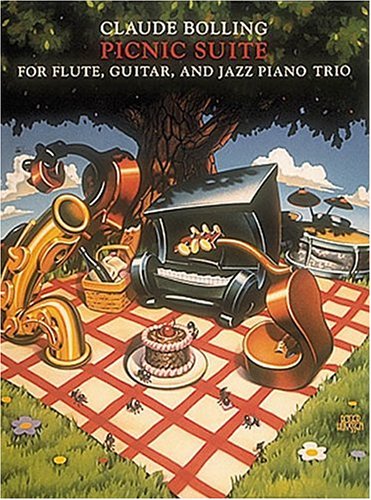
Picnic Suite


J. J. Quantz Scores

6 Duets for 2 Flutes
QV 3:2 (Op.2)
Concerto for 2 Flutes
QV 6:1 | D major
Concerto for 2 Flutes
QV 6:7 | G major
Concerto for 2 Flutes
QV 6:8a | G minor
Concerto for 2 Oboes
QV 6:3 | E minor
Concerto in G major
QV 6:Anh.2
Flute Concerto
QV 5:45 | D major
Flute Concerto
QV 5:174 | G major
Flute Concerto F major
QV 5:139
Flute Concerto G major
QV 5:169
Flute Sonata
QV 1:86 | F major
Trio Sonata
QV 2:40 | A minor
Trio Sonata
QV 2:41a | A minor
Trio Sonata
QV 2:42 | B-flat major
Trio Sonata
QV 2:43 | B minor
Trio Sonata
QV 2:3 | C minor
Trio Sonata
QV 2:10 | D major
Trio Sonata
QV 2:12 | D major
Trio Sonata
QV 2:13 | D major
Trio Sonata
QV 2:14 | D major
Trio Sonata
QV 2:15 | D major
rio Sonata
QV 2:7 | D major
Trio Sonata
QV 2:9 | D major
Trio Sonata
QV 2:18 | E-flat major
Trio Sonata
QV 2:20 | E minor
Trio Sonata
QV 2:21 | E minor
Trio Sonata
QV 2:28 | G major
Trio Sonata
QV 2:29 | G major
Trio Sonata
QV 2:34 | G minor
Trio Sonata
QV 2:35 | G minor
Trio Sonata in A major
QV 2:Anh.31
Trio Sonata in A major
QV 2:Anh.32
Trio Sonata in A minor
QV 2:Anh.34
Trio Sonata in C major
QV 2:Anh.2a
Trio Sonata in C major
QV 2:Anh.3
Trio Sonata in C minor
QV 2:Anh.4
Trio Sonata in C minor
QV 2:Anh.5
Trio Sonata in D minor
QV 2:Anh.9
Trio Sonata in E minor
QV 2:Anh.12a
Trio Sonata in E minor
QV 2:Anh.14
Trio Sonata in E minor
QV 2:Anh.15a
Trio Sonata in E-flat major
QV 2:Anh.10
Trio Sonata in F major
QV 2:Anh.29
Trio Sonata in F minor
QV 2:Anh.18
Trio Sonata in G major
QV 2:Anh.19
Trio Sonata in G major
QV 2:Anh.20
Trio Sonata in G major
QV 2:Anh.23
Trio Sonata in G major
QV 2:Anh.26
Trio Sonata in G major
QV 2:Anh.27
Trio Sonata in G major
QV 2:Anh.28
sábado, 12 de noviembre de 2011
Rolla - Flute Chamber Music - M. Carbotta


Alessandro Rolla
Alessandro Rolla (22 April 1757 – 15 September 1841) was widely acknowledged in his time as a violin and, especially, viola virtuoso, composer and teacher. His contribution to technique, repertoire and history of music is greatly underestimated.[citation needed] His son, Antonio Rolla, was also a violin virtuoso and composer.
His fame now rests mainly as "teacher of the great Paganini", yet his role was very important in the development of violin and viola technique. Some of the technical innovations that Paganini later used largely, such as left-hand pizzicato, chromatic ascending and descending scales, the use of very high positions on violin and viola, octave passages, were first introduced by Rolla.
Life
Rolla was born in Pavia, Italy in 1757 and after his initial studies he moved to Milan where, from 1770 to 1778, he studied with Gian Andrea Fioroni, Maestro di cappella at Milan Cathedral, who was the most important musician in Milan after G. B. Sammartini. Charles Burney, in his musical tour in Italy, refers to Fioroni to acquire information about the Ambrosian Chant.
In 1772, at 15, he made his first public appearance as a soloist and composer performing “the first viola concerto ever heard”, as reported by a contemporary writer. However, this is in fact false, as the first ever viola concerto was written several years earlier by Telemann (Concerto in G Major for Viola and String Orchestra).
In 1782 he was appointed principal viola and the leader of the Ducale Orchestra in Parma, playing violin and viola until 1802. This was the most profitable period of Rolla’s life, his most serene and creative years, in a very stimulating cultural and intellectual atmosphere; he was allowed to travel to conduct and perform as a soloist, became known also abroad and his works were published in Paris and Vienna.
In 1795 he received a visit by the young Paganini wishing to study with him and from Paganini’s later letters there is evidence that they remained in contact and even played quartet together. This relationship must have had an influence on Paganini, as far as his love for the viola is concerned, which in his maturity led him to compose works of great interest for the instrument, such as the concert piece Sonata per la Grand Viola e Orchestra, the Serenata and Terzetto concertante, besides the Quartet n.15 for Viola Concertante, violin, guitar and cello.
After the death of the Duke of Parma, in 1802 Rolla was offered a position as leader and orchestra director of the La Scala Orchestra in Milan. Here the new governors, the French and later the Austrians, wanted to create the most important orchestra of Italy and therefore hired the best virtuosos of the time. Among his students during this period were Cesare Pugni, the prolific composer of ballet music, whom he taught the violin. Rolla would conduct many of Pugni's operas for La Scala, among them Il Disertore Svizzero (1831) and La Vendetta (1832).
At La Scala Rolla remained until 1833. There he conducted the first Milanese performances of Mozart’s Don Giovanni, Così fan tutte, Clemenza di Tito and Nozze di Figaro and Beethoven’s first Symphonies. During this period he also conducted about eighteen operas of the then most loved opera composer, Gioacchino Rossini, as well as operas by Donizetti and Bellini, whom he got to know personally.
Since 1811 he was also director of a Cultural Society where musicians used to perform chamber music works by Haydn, Mozart and Beethoven, among others. In 1813 at this Cultural Society he gave private performances of Beethoven’s Fourth, Fifth and Sixth Symphonies. He also used to be in the aristocracy drawing rooms, meeting artists and poets, playing for them and dedicating them several compositions.
In 1808 the Conservatoire of Music in Milan was inaugurated and Rolla was appointed professor of violin and viola. In this capacity he composed many didactical works for his own pupils, graded in difficulty, many of which were published by the newly established publishing house Ricordi. Several of these esercizi are composed with progressive technical difficulties and in all keys.
It is also curious to note that Rolla was a member of the adjudicating commission that rejected another famous Parmesan, Giuseppe Verdi, at the entry examination in the Conservatoire of the city, although he was the only one who expressed a favourable judgement about the young student.
Although involved in opera conducting in a period when in Italy opera was dominating over instrumental music, Rolla continued to compose, maintaining the Italian instrumental tradition high. He wrote about 500 works, from didactical compositions to sonatas, quartets, symphonies, concertos for violin, not less than 13 concertos and other works for viola and orchestra. Significant was his contribution to the diffusion of Beethoven’s works in Italy and his familiarity with Beethoven and other Viennese composers is shown in his compositions. He continued to compose and play chamber music until few months before his death at 84.
His works and performances as a violin and viola player and conductor at La Scala were often reviewed and appreciated in the Leipziger Zeitung.
As an example of his fame in Italy and abroad, it’s worth noting that during his lifetime his compositions were published by publishers such as Le Duc and Imbault in Paris, Artaria in Vienna, Breitkopf & Hartel in Leipzig, Monzani & Hill in London, André in Offenbach, Ricordi in Milan from 1809, and many more.
This information about Rolla’s life and multifarious musical activity helps us interpret his work. He was a musician of European vision, an innovator in his own field who was also able to learn from the best of his contemporaries. Also being so deeply immersed in opera environment undoubtedly had an influence on his style as a composer. He often used themes from operas for his variations.
Because of the technical innovations introduced, his work might be considered helpful for the development of viola technique.
His style varies from the very melodic phrases, typically operatic in character, rich in fiorituras, to the extremely virtuoso writing, the style we are used to identify with Paganini. Ingredients of this technique are an ample use of double stops, fast passages in thirds and sixths, octaves from the first to the eighth position, very fast ascending and descending diatonic and chromatic scales, flying staccato, left-hand pizzicato. This intense virtuosity was a new innovation for viola technique, practically unheard of in previous times. Bertini, a historian of his time, in a dictionary of musicians reported that Rolla was prohibited to play in public because women could not hear him without fainting of being struck by attacks of nerves.
Some[who?] think Rolla deserves a more important position in viola repertoire. His didactical works, conceived especially for the viola, are of special interest for students and teachers. They are often conceived in form of duos, lending themselves to be used also for chamber music education purposes as well.
Many of his works have been published in modern times and are therefore available.
Mario Carbotta
Appreciated by the public and by the international critics (Flutist Carbotta is simply superb, Audiophile Audition Classical; Quant au flutiste Mario Carbotta il a des ailes, Repertoire; Carbotta plays the pieces with a nice tone and an excellent technique, Fanfares; Les interprètes sont d'une musicalité et d'un goût parfaits , Le Monde de la Musique) he has played all over Italy, in many countries of Europe, Middle East, North Africa, Asia, Mexico, Canada and the United Statesof America.
After obtaining a full marks diploma at the Conservatory of Piacenza, he attended Mario Ancillotti’s Postgraduate Courses at the School of Music in Fiesole, winning in the meantime a lot of prizes in musical competitions, the most important being the "F. Cilea" in Palmi.
He has performed in some of the most prestigious concert halls: Grosser Musikvereinssaal in Vienna, Rudolfinum in Prague, Auditorium of the Swiss Radio in Lugano, "G.Verdi"Hall in Milan’s Conservatorio, Glenn Gould Studios in Toronto, Tiara Koto Hall in Tokyo, Auditorium Manuel de Falla in Granada, Cairo Opera House, Poly Theatre of Peking, Lithuanian Philarmonica of Vilnius, and renowned events, such as the international Festival of Santander, Castel de Perelada, Torre del Lago Puccini, Ljubljana, Varajdin, Zagreb and Teheran.
As a soloist, he has played with famous chamber orchestras (Mannheim Kammerorchester, Mainzer Kammerorchester, DKO Frankfurt, Silesian Chamber Orchestra Katowice, Solisti Aquilani, I Virtuosi di Praga, Archi della Scala) and symphonic orchestras (Tonkünstler-Orchester Niederösterreich of Vienna, Karntner Sinfonieorchester of Klagenfurt, Thüringer Symphoniker, Südwestdeutsche Philharmonie Konstanz, Loh-Orchesters Sondershausen, the Symphonette Orchestra of Israel, the Symphonic Orchestra of Istanbul, the Radiotelevison and Film Orchestra of the Popular Republic of China, Cairo Symphony Orchestra, the Orquestra do Algarve and Orquestra Classica de Madeira in Portugal, the Orchestra I Pomeriggi Musicali of Milano, Orchestra of the Provincia di Bari, the Symphonic Orchestra of Sanremo and in the United States with the Symphonic Orchestras of Amarillo, Altoona, Garland, Las Cruces and Longmont), with the conductors Philippe Bender, Philippe Bernold, Elio Boncompagni, Alvaro Cassuto, Diego Fasolis, Piero Gamba, Hiroaki Masuda, Matthias Maurer, Jan Stulen, Alberto Veronesi.
He has performed for the first time ever some pieces by a number of Italian contemporary composers - among them Pieralberto Cattaneo, Roberto Cognazzo, Paola Crisigiovanni, Federico Ermirio, Vittorio Fellegara, Gianluigi Gelmetti, Gianni Possio, Riccardo Piacentini, Alessandro Solbiati, Stefano Taglietti, Andrea Talmelli - some of which dedicated to him.
In addition to the artistic activity, Carbotta has constantly devoted himself to research on a lot of forgotten but important authors and to divulge his rediscoveries. He has edited the sonatas of Gianandrea Fioroni, Pietro Nardini, Peter Lichtenthal and Alessandro Rolla for the publishers Suvini Zerboni, Bèrben, Carisch and Rugginenti.
His discography for Dynamic, Tactus, Nuova Era and Rugginenti includes the first recordings in our times of Giuseppe Sammartini, Mario Pilati, the whole work for flute by Nino Rota, the Lieder by Caspar Fürstenau (recorded with the choir of the Swiss Radio of Lugano directed by Diego Fasolis), the integral duets for flute and violin (with Luigi Alberto Bianchi), the chamber music and the concert for flute and orchestra by Alessandro Rolla, the Triple concert "Degli oleandri" by Raffaele Gervasio (with the Orchestra Sinfonica Lucana), "Memories from concert" of Gianni Possio (with the voice of David Riondino) and the whole concerts for flute and orchestra by Saverio Mercadante (with the Solisti Aquilani).
He has also run courses and master classes in the USA at the Amarillo University (Texas) and at the Louisiana University, at the International Academy of music in Milan and in Poland at the Katowice Music School and at the International Summer Courses of musical interpretation in Nowy Sacz.
viernes, 11 de noviembre de 2011
Beethoven - Flute Sonatas & Serenade - E. Pahud

Emmanuel Pahud

Emmanuel Pahud (b. January 27, 1970) is a Swiss flute player.
He was born in Geneva, Switzerland. His father is of French and Swiss background and his mother is French. The Berlin-based flutist is most known for his baroque and classical flute repertory.
Pahud was born into a non-musical family. As a young boy living in Italy, the sounds of the flute captivated Pahud. From the age of four to the age of 22, he was tutored and mentored by flutists such as François Binet, Carlos Bruneel and Aurèle Nicolet. Classically trained at the Conservatoire de Paris, he leapt into the international orchestral and solo music scene when he joined the Berlin Philharmonic Orchestra in 1992.
His versatility in music styles over the years has “signalled the arrival of a new master flautist” (The Guardian). He plays in diverse music genres, whether baroque, jazz, contemporary, classical, orchestral, or chamber music.
Biography
Early life
Travelling has been a big part of Emmanuel Pahud's life from birth. His father worked for a U.S. company, and the family moved repeatedly during his childhood. However, this would only shape Pahud's international outlook for his future. Only six weeks after Pahud was born, his parents moved to Baghdad for one year. They moved again when he was 1 to Paris, where Emmanuel's younger brother was born. In 1972, they then moved to Madrid for two years, and in 1974, finally settled in Rome for four years. In their apartment building in Rome, lived the Swiss-French Binet family whose four children played musical instruments. The father (François) was a flautist who studied in Zurich and Paris but stopped performing in later years. At the age of four, Pahud first heard the flute. As the eldest son Philippe played the Flute Concerto No. 1 (Mozart) K.313 in G Major, it set the course to a remarkable chapter of Pahud's life. He recalls:
I could hear the flute, the violin, the cello, the piano. I don't know why I chose the flute but maybe it was because the eldest son was playing it, so he was the one playing at the best level at that time - or because the father was also a flute player, so there was a kind of authority there. Anyhow, I said to my parents, "I want to play the flute, I want to play the Mozart concerto that guy next door is practicing."
That Christmas, after receiving his first flute, Pahud began his first year of lessons with Philippe (who was only 15 years old) and the next three years with Phillipe's father, François.
In 1978, at the age of eight, the Pahud family moved to Brussels, Belgium. Emmanuel then began studying at the Music Academy of Uccle in Southern Brussels. There he studied with Michel Moinil from 1979-1985. As he became more determined and focused on playing the flute at a higher level; Pahud began to study from 1984-87 with Carlos Bruneel, the then and current principal flautist of the Théâtre Royal de la Monnaie opera house in Brussels. In 1985, Pahud won the National Competition of Belgium (le concours National de Belgique) and in the same year, he played his first concert with the National Orchestra of Belgium, performing the piece that inspired him 11 years earlier: Mozart Concerto K.313 in G Major. Pahud remained in Brussels until receiving his A-Level at the age of 17 and went off to finish his schooling in Paris. With the strong support of his family, he also received lessons with other of Europe's finest players, including Peter-Lukas Graf in Basel.
Studies and early accomplishments
Pahud attended the Conservatoire de Paris (Conservatoire National Supérieur de Musique de Paris) in France, studying with Michel Debost, Alain Marion, Pierre Artaud, and Christian Larde. Whilst studying, he won two major competitions, one in Duino 1988 and the other in Kobe in 1989. In 1988, Emmanuel also won the 2nd Prize at the International Scheveningen Music Competition in Scheveningen, Netherlands. Winning these competitions put Pahud in the forefront to become principal flautist in the Basel Radio Symphony, under the direction of Nello Santi which he obtained the position in 1989 whilst finishing his studies in Paris. He resigned from the orchestra in 1992. Pahud also held the principal flautist position at the Munich Philharmonic under Sergiu Celibidache. Pahud graduated at the age of 20 from the Conservatoire in 1990, obtaining the First Prize (Premier Prix). He then continued to advance his studies for the next two years; in style and interpretation with one of France's greatest flautists, Swiss-born Aurèle Nicolet who turned out to be his neighbour. In 1992, Nicolet prepared Pahud in an extensive 10 day rehearsal for both the Geneva International Music Competition, or le Concours International de Genève in September of that year and the audition for principal flautist of the Berlin Philharmonic Orchestra (BPO) in October. He acknowledges achieving both the first prize at le Concours International de Genève and being appointed for the position at the age of 22 by BPO's conductor, Claudio Abbado to his experience with Nicolet.
Career
Berlin Philharmonic Orchestra
Being appointed as principal flautist at the BPO signalled Pahud's entrance into the international spotlight. He entered the orchestra during its rejuvenation period as the post-war generation of players began to retire. Over 40%, including Pahud's position was up for audition, or on trial. His predecessor was Karlheinz Zöller (1960–69, 1976–93). Apart from Pahud, other previous international flautists held the same principal flautist position such as Aurèle Nicolet (1950–59) and Sir James Galway (1969–75). As many international musicians filled these positions; Pahud found the BPO generating a unique sound experience unlike anywhere else:
There was a way of phrasing and wave that goes throughout the orchestra, coming from the bass and shaping the phrase with amazing beauty and intensity. The dynamic range of the orchestra was phenomenal. The art of playing with the Berlin Phil is very different compared to other Orchestras, where we work as equals with our individual voice.Pahud at 22 was the youngest player in the Berlin Philharmonic, a position to which he returned in 2002 under Sir Simon Rattle after taking a 18 month sabbatical in 2000 in order to teach the Virtuosity Class at the Conservatoire de Musique de Genève for one year and to perform in concerts worldwide. He was surprised on how emotional it was to leave the BPO. He recalls his emotions beginning a couple of hours before playing his last concert and only leaving him once he rejoined BPO in 2002. The versatility and authority of current conductor Sir Simon Rattle, says Pahud, gives the orchestra a unique working partnership and a capacity to be more adventurous in its exploration of repertoire. He also sees Rattle as an intellect; "he knows the orchestra and he achieves what he wants by taking into account the vision of the musicians. In addition, Pahud also observed that whilst the former conductor Herbert von Karajan "produced a big string sound with a great legato. The Rattle sound is a very transparent and constructed sound, with much more articulation to achieve definition in the sound." In baroque and classical music, this represents the influence of period performance.
The Berlin Philharmonic these days considers themselves a very individualist and soloistic "large ensemble." In 2007, Pahud was voted onto the Media Vorstand (or the Member of the Media Board) of the BPO. He currently shares the position of Principal Flautist with Andreas Blau who has held the position since 1969.
International appearances
Pahud's workload has more than tripled since the early days of his international career in 1992. At that time he was doing about 50 concerts a year - but with the success of his solo career and continued involvement with the Berlin Philharmonic Orchestra, that number has spiralled to around 160; 90 solo or chamber music and 75 orchestral concerts in an average year – roughly twice the number of performances that most musicians would consider a heavy work-load. Pahud says that it's a balance he has had all his life and what prevents him from being isolated in one genre or repertoire of music, or what he calls "a musical corner".
In 1993, Pahud began accepting international concert performances soon after settling into his position in Berlin. He has appeared as soloist with internationally renowned orchestras in addition to the Berlin Philharmonic: the Yomiuri Nippon Symphony Orchestra, the London Symphony Orchestra, the Tonhalle Orchester Zurich, L'Orchestre de la Suisse Romande, the Berlin Radio Symphony Orchestra (East Berlin), and the Danish Radio Symphony also known as the Danish National Symphony Orchestra. He also appears regularly at leading festivals throughout Europe, the United States and the Far East. His more famous international concerto appearances and collaborations of the past few seasons (2005–2008) included the Berlin Philharmonic, the Baltimore Symphony Orchestra, the London Philharmonic Orchestra, the Monte-Carlo Philharmonic Orchestra, the Bavarian Radio Symphony Orchestra, the NHK Symphony Orchestra, the Berliner Barock-Solisten, the Vienna Radio Symphony Orchestra, the Orchestre National de Belgique, the Orchestre Philharmonique de Radio France and a U.S. tour with the Barcelona Symphony and Catalonia National Orchestra (including a Carnegie Hall debut). Another famous concerto collaboration took place in 2005-2006 with the Australian Chamber Orchestra in reviving the Vivaldi Flute Concertos.
Pahud is also a dedicated chamber musician and has recently made international appearances throughout Europe, North America and Japan in recital with pianists Éric Le Sage and Stephen Kovacevich as well as in a flute and string quartet formation with Christoph Poppen (violin), Hariolf Schichtig (viola) and Jean-Guihen Queyras (cello) with whom he recorded his 1999 record Mozart Flute Quartets. In 1993, he co-founded Le festival de l'Empéri in Salon-de-Provence, France, along with his regular chamber music partners pianist Éric Le Sage (close friend and confidant) and Paul Meyer (clarinetist). In a French interview, Pahud describes the success of the festival as a project "filled with enthusiasm and fun" where the public has "recognised our work, our fellow artists, musicians and actors and have the desire to come back regularly." He also describes the festival as a "musical laboratory" which avoids the programming of works that the public are used to hearing in concert halls. It is about "daring to combine performers, works (music), create new collaborations and by taking risks. Pahud has made several recordings and performed internationally with pianist Éric Le Sage throughout his career. In 2008 he performed for the first time at the Jerusalem International Chamber Music Festival, where he played in the world premier of Elliot Carter's Flute Concerto, conducted by Daniel Barenboim. He returned to the Festival on 2009 to play in a series of concerts.
Musical styles and recordings
Pahud describes his versatility over the years in music, as transforming himself into a chameleon who tries to match the colour of the music, or the idea he has of it, to what the composer had in mind. But his discography and career has also been built on encounters; both professionally and human relationships. He expresses in playing like a chameleon, "I try to change style, colour and phrasing, the way I breathe and articulate to suit the piece I am playing. I do not represent any particular national style." Pahud seems himself as a performer/actor rather than a composer/creator. For the Dalbavie Record (2008) Pahud dedicated himself to commissioning new works and to start new flute concertos; performing them for the first time on stage. Three composers were selected: Marc-André Dalbavie (French), Michael Jarrell (Swiss), and Matthias Pintscher (German) reflecting Pahud as a French and Swiss citizen living in Germany for over 15 years. Whilst working with German Composer, Matthias Pintscher; Pahud sought to explore a new level and style of playing the flute. He recalls:
We spent some time talking about the effects and about the special way of using the instrument. The most interesting thing is how you interconnect these various effects [from an instrument] that is one of the oldest on earth. Whether you blow on it, in it, or you use it as a trumpet or a recorder; you can have a lot of different sounds on such an instrument. But that's nothing new about it, the new thing is how you can combine them and how you can get them to interconnect so that it becomes one musical statement; one phrase.In March 2008 Pahud performed the World Première of another work commissioned by Frank Michael Beyer, who composed Meridian, a Concerto for Flute & String Ensemble. Other World Premières include music composed by Elliot Carter: Concerto for Flute & Ensemble, which Pahud premièred in September 2008 in Jerusalem. It was joint commissioned by the BPO, Jerusalem International Chamber Music Festival and Boston Symphony Orchestra. Pahud will World Première the Flute Concerto by Luca Lombardi in 2010, commissioned by the Kansas City Symphony.
Though he is an enthusiastic consumer and commissioner of new music, Pahud sounds most excited when relishing the old repertoire. “Mastery of an instrument helps you to sense new barriers. This is where you keep music moving," and he acknowledges his various experiences with newer flute compositions as benefiting the way he performs his traditional repertoire. Pahud sees the future of interpretation (of music) will always be a blend of "tradition and novelty." But to him, this concept is not a novelty in itself. Many composers have evolved from traditions such as Bach for Fortepiano and Beethoven for the Hammerklavier. Pahud sees the term "tradition" as often being used to disguise the past, a lack of evolution or in denial of progress. But to him, the meaning of tradition is something evolving. He adds, "Artists such as Wilhelm Furtwängler, Herbert von Karajan, Claudio Abbado and Simon Rattle (conductors of BPO) were or are in line with tradition and make it evolve. In complete unconsciousness they feed from the past to define the future. That is one of the secrets of these great artists."
In most interviews, Pahud describes music/musical styles in terms of "phrasing" or a Phrase (music). In musical terms, this refers to "a musical unit, often a component of a melody. The phrase may be regarded as a dependent division of music, such as a single line of poetry; it does not have a sense of completion in itself. Usually two or more phrases balance each other." It is like a grammatical construction with words to stress. Musical phrasing is also expressed in terms of how the music is executed. In terms of style of the Dalbavie concerto itself, Pahud reflects how the flute finds a resonance within the orchestra whilst maintaining its virtuosic, colourful and sensual phrasing. In interpreting the poetic style of Jarrell, where the imagination of both the composer and of the audience are "immensely present" in his writing; Pahud describes, "This is something to me I like a lot in music is exactly what you cannot express with words but that its all there in the essence of the music." On reflecting the style of the famous flutist Jean-Pierre Rampal,
[Rampal] brought something new and unusual in terms of sound, class and grandeur of the expressive aspect of the flute. He was able to perform admirable phrases that never seemed to end, or how the breathing faded into the musical flow; and his ability to make the sound of the flute seem to extend endlessly, infinitely.Pahud’s debut into the world of jazz came through meeting and collaborating with jazz pianist Jacky Terrasson. He admires and derives inspiration from jazz flutists such as: James Newton, James Moody (saxophonist) (also a flute player), Herbie Mann, and Jeremy Steig. He has explored jazz further through performing big band music with friends and colleagues from the Berlin Philharmonic and local jazz musicians. Other examples of his vast interests in innovative musical genres include so-called “one-time projects” (as Pahud calls them); most recently in 2006, it included a collaboration project with the NHK Symphony Orchestra of a recorded original soundtrack for the NHK Taiga series Komyo ga Tsuji (Jp: 功名が辻).
For the many that come to see Pahud perform, either jazz or classical; it is not only about entertaining. Pahud reflects on his audiences being able to learn about music at his performances; it is about reacting at different levels and ranges of emotions. To Pahud, it is about interacting, connecting and enabling the audience to think about what is happening as the music is being played. He wants to open opportunities in developing curiosity to discover more about music as a way of giving back to the audience.
In 1996 he signed an exclusive contract with EMI Classics, the only flutist in the world to have a solo recording contract with a major record company. Pahud promises to be one of the most significant contributors to the catalogue of recorded flute music today. Nowadays much of his time is taken up with recording. He extended his contract with EMI for a further six years. Recording adds a welcome diversity to Pahud's schedule:
I like to work for the mic - it brings a certain close-up on your playing. You have to take care of lots of things that you do not necessarily have to take care of when you are performing in a live concert hall. You don't have the emotional or the visual support, and you have to be exciting nevertheless. So at the same time you have to take greater care of the detail and bring a greater intensity to the music.Pahud has recorded and/or collaborated a total of 22 discs with EMI.
Instrument
Pahud's first flute was a silver-plated Yamaha. His parents later bought him two Muramatsu Flutes, one half hand-made and the other fully hand-made. Pahud currently plays a 14-karat golden flute which he bought from Brannen Brothers in Boston, Massachusetts in 1989 with money he won from competitions. Two weeks later he bought a head joint (the part into which the player blows) from Dana Sheridan, another Boston flute manufacturer. Pahud chose the Brannen flute body because it is one of the only flute makers that produce a decent Cooper scale, based on the scales developed by Albert Cooper (flute maker). He describes his instrument:
This is the most flexible instrument I have tried so far. It enables me to transpose into music what I'm thinking and what I'm feeling. But, although the instrument is important, the player is the most important. All the work must be done before the mouth even makes contact with the instrument. It all happens by the way you hold your muscles, control your lungs, use the different cavities in the head and the upper body to let the sound resonate more or less.
Download: