


 Marian

Mostrando entradas con la etiqueta Chamber Music. Mostrar todas las entradas
Mostrando entradas con la etiqueta Chamber Music. Mostrar todas las entradas
domingo, 25 de diciembre de 2011


Milhaud - Le retour de l'enfant prodigue - feat. J. P. Rampal


Darius Milhaud (4 September 1892 – 22 June 1974) was a French composer and teacher. He was a member of Les Six—also known as The Group of Six—and one of the most prolific composers of the 20th century. His compositions are influenced by jazz and make use of polytonality (music in more than one key at once). Darius Milhaud is to be counted among the modernist composers.
Life and career
Born in Marseilles to a Jewish family from Aix-en-Provence, Milhaud studied in Paris at the Paris Conservatory where he met his fellow group members Arthur Honegger and Germaine Tailleferre. He studied composition under Charles Widor and harmony and counterpoint with André Gedalge. He also studied privately with Vincent d'Indy. As a young man he worked for a while in the diplomatic entourage of Paul Claudel, the eminent poet and dramatist, who was serving as French ambassador to Brazil.
On a trip to the United States in 1922, Darius Milhaud heard "authentic" jazz for the first time, on the streets of Harlem, [2] which left a great impact on his musical outlook. The following year, he completed his composition "La création du monde" ("The Creation of the World"), using ideas and idioms from jazz, cast as a ballet in six continuous dance scenes.
In 1925, Milhaud married his cousin, Madeleine (1902–2008), an actress and reciter. In 1930 she bore him a son, the painter and sculptor Daniel Milhaud, to be the couple's only child.
The rise of Nazism forced the Milhauds to leave France in 1939,[1][not in citation given] and then emigrate to America in 1940 (his Jewish background made it impossible for Milhaud to return to his native country until after its Liberation). He secured a teaching post at Mills College in Oakland, California, where he collaborated with Henri Temianka and the Paganini Quartet. In an extraordinary concert there in 1949, the Budapest Quartet performed the composer's 14th String Quartet, followed by the Paganini's performance of his 15th; and then both ensembles played the two pieces together as an octet. The following year, these same pieces were performed at the Aspen Music Festival in Colorado, by the Paganini and Juilliard Quartet.
The jazz pianist Dave Brubeck became one of Milhaud's most famous students when Brubeck furthered his music studies at Mills College in the late 1940s (he named his eldest son Darius). In a February 2010 interview with Jazzwax, Brubeck said he attended Mills, a women's college (men were allowed in graduate programs), specifically to study with Milhaud, saying "Milhaud was an enormously gifted classical composer and teacher who loved jazz and incorporated it into his work. My older brother Howard was his assistant and had taken all of his classes."[cite this quote]
Milhaud's former students also include popular songwriter Burt Bacharach. Milhaud told Bacharach, "Don't be afraid of writing something people can remember and whistle. Don't ever feel discomfited by a melody".
Milhaud (like his contemporaries Paul Hindemith, Gian Francesco Malipiero, Alan Hovhaness, Bohuslav Martinů and Heitor Villa-Lobos) was an extremely rapid creator, for whom the art of writing music seemed almost as natural as breathing. His most popular works include Le bœuf sur le toit (a ballet which lent its name to the legendary cabaret frequented by Milhaud and other members of Les Six), La création du monde (a ballet for small orchestra with solo saxophone, influenced by jazz), Scaramouche (for Saxophone and Piano, also for two pianos), and Saudades do Brasil (dance suite). His autobiography is titled Notes sans musique (Notes Without Music), later revised as Ma vie heureuse (My Happy Life).
From 1947 to 1971 he taught alternate years at Mills and the Paris Conservatoire, until poor health, which caused him to use a wheelchair during his later years (beginning sometime before 1947), compelled him to retire. He died in Geneva, aged 81.


Telemann, Heinichen, Marcello - Concerti di flauti - Amsterdam Loeki Stardust Quartet


Since its formation the Amsterdam Loeki Stardust Quartet has explored the boundaries of the recorder consort. Its musical adventure started in 1978 when studying at the Sweelinck conservatory in Amsterdam and discovering the quartet as a new phenomenon. The ensemble's reputation grew quickly when they emerged as the winner of the 1981 Musica Antigua Competition in Bruges despite testing the competition rules by performing an unusual arrangement of a Stevie Wonder song.
What followed was the recognition as a serious ensemble of unparalleled virtuosity, a recording contract with Decca and the start of an international career. Both their playing style and choice of repertoire, something unheard of at the time, made them appear at many festivals and they toured throughout Europe the United States, South America and Japan.
Their unusual name refers to a melody played on their very first rehearsal. It expresses affection for unusual repertoire in addition to the classic consort music of the Renaissance and Baroque periods. A number of composers have been inspired to write for the Quartet, which has helped create a new repertoire that proves the instrument to be an important voice of our time. Graham Fitkin, Tristan Keuris, Chiel Meijering, Peter Jan Wagemans, Philip Wharton en Lera Auerbach are amongst the many composers who wrote for the quartet.
The Quartet also contributes to the expansion of the recorder repertoire by publishing a series of new recorder music and through the collaboration with recorder makers. The Boston based instrument maker Friedrich von Huene designed a fully keyed bass and contrabass recorder allowing the group amongst others to perform and record Bach’s Art of Fugue. The group has assembled a unique collection of over a hundred Renaissance, Baroque and modern recorders, ranging from an 8-inch sopranino to a sub-contrabass measuring over nine feet. The quartet’s recordings (for L'Oiseau-Lyre, Decca and Channel Classics) have confirmed its reputation as the world's most innovative and exciting recorder consort.
sábado, 24 de diciembre de 2011
J. S. Bach - Complete Flute Sonatas vol. 1 & 2 - K. Kaiser


Karl Kaiser studied at the Colleges of Music in Cologne and Münster. Parallel to this he also studied theology, philosophy and musicology at the universities in Bonn and Cologne, ultimately deciding on a musical profession. Since then he has made an excellent name for himself as a soloist, chamber and orchestral musician in the area of historically informed performance techniques.
After gaining wide-ranging and inspiring experience in the most varied of orchestras and groups for historical music, Karl Kaiser now concentrates on a few complementary ensembles. He has been a flautist at the Camerata Cologne for almost 30 years, with worldwide concerts and more than 50 CDs covering a large part of the Baroque and early classical chamber music.
He has been a member and flautist of the Freiburg Baroque Orchestra for many years and is constantly underway worldwide with this ensemble as an orchestral musician and soloist. Karl Kaiser is also a founding member and flautist of the La Stagione orchestra in Frankfurt under Michael Schneider. Karl Kaiser plays early Romantic chamber music with Petra Müllejans (violin) and Sonja Prunnbauer (guitar) on original instruments in the trio Sérénade à Trois.
Karl Kaiser is an enthusiastic and all-embracing teacher. He is Professor for Historical Flutes and Performance Techniques at the College of Music and Performing Arts in Frankfurt and at the College of Music in Freiburg. He regularly gives master courses and holds presentations on performance techniques of the 18th century. He has published articles in newspapers and a book of his, Fundamental Knowledge of Baroque Music was published by the con brio Verlag. Karl Kaiser sees his teaching activities as being within a higher-ranking framework – beyond the pure communication of skills.
Vol. 1
jueves, 8 de diciembre de 2011
Platti - Six Flute Sonatas - P. Whalberg


Paul Wåhlberg teaches flute at the world’s northernmost music academy in Tromsø, Norway, and lives in the tiny community of Godfjord. He was trained in Göteborg, Zürich and The Hague, and has since performed extensively, specializing in early instruments. He was one of the founders of the Norwegian Baroque Orchestra, which has been touring most of Europe. With this ensemble he has recorded music by Bach and the Norwegian eighteenth century composer Johan Henrik Freithoff. He also founded the group Musica Domestica which has appeared throughout Great Britain and Scandinavia.


Locatelli - Flute Sonatas - J. Wentz


Jed Wentz began his flute studies with Walter Mayhall in Youngstown, Ohio, and continued studying with James Walker in Pittsburgh, Pennsylvania. He studied modern and historical flutes at the Oberlin Conservatory of Music with Robert Willoughby and Michael Lynn, and received a Soloist's Diploma from the Royal Conservatory in The Hague after three years with Barthold Kuijken. He has performed and recorded with groups such as Musica Antiqua Koln, Les Musiciens du Louvre, Capriccio Stravagante Paris and the Gabrielli Consort. In 1992 he founded Musica ad Rhenum, with whom he has recorded more than 20 CDs both as flutist and conductor. His recording of the complete flute sonatas of Locatelli was awarded the prize for the Best Recording of Italian Music 1995 by the Fondazione Cini Venetia. Mr. Wentz teaches at the Amsterdam Conservatory of Music, and lectures regularly on performance practice at the Royal Academy of Music in London. He has published articles in Early Music, Concerto, and Tijdschrijft voor Oude Muziek. He is pursuing his doctorate through Leiden University, with his research centering on the relationship between 18th-century staging and tempo in the tragedie en musique.
LINKS:


viernes, 2 de diciembre de 2011
Bach - Sonatas for Flute & Harpsichord - R. Stallman


The unusual creativity of Robert Stallman's long and distinguished career as solo flutist, chamber musician, recording artist and master teacher has won the highest respect from the international press. American Record Guide has called Stallman "a consummate artist", while a BBC critic notes, "Stallman's claim to a special place among the world's masters of the flute rests in the daring artistry he demands of himself in every situation."
Stallman’s schedule has included appearances around the world from New York's Lincoln Center and Carnegie Hall to London's Wigmore Hall, Vienna's Konzerthaus and Tokyo's Suntory Hall; festivals such as Mostly Mozart (New York), Musique à Cimiez (France), Ceský Krumlov (Czech Republic), and Kuhmo (Finland); and solo performances with the American Symphony, Strings of the Philadelphia Orchestra, the Royal Philharmonic and numerous chamber orchestras.
Robert Stallman has long made it his mission to expand the flute repertoire with apt transcriptions, gratifying flutists everywhere. With over 70 publications from prominent houses in the US and the EU, he has emerged as the preeminent editor and arranger of flute music active today. Meanwhile Stallman’s communicative gift inspires composers. Major works dedicated to him include the Dodgson and McKinley Flute Concertos, both recorded by Stallman, and Kukal’s new “Flautianna” Concerto, which he premieres in 2009 and 2010 with the Czech Chamber Orchestra.
In 1977, Stallman founded the Cambridge Chamber Players and the Marblehead Summer Music Festival in Massachusetts, where for twenty years he created a unique series of chamber music concerts, broadcast regularly on WGBH and called “special occasions in every sense of the word” by The Boston Globe. It was for these concerts that Stallman began to refine his skills as an arranger and to expand the chamber music repertoire for flute with his re-creation of works by Mozart, Schubert, Bach, Beethoven, Dvorak, Mendelssohn and others.
Stallman has collaborated with many other chamber ensembles, including the Chamber Music Society of Lincoln Center, the Alexander, the Mendelssohn, the Muir and the Orion Quartets in the US, as well as the St. Lawrence Quartet of Canada, the Artis Quartet of Vienna, and both the Vlach and the Martinu Quartets of the Czech Republic. Stallman was a special guest in Vienna’s celebration of the Mozart 250th, joined by the Martinu Quartet in the Schubertsaal, performing his Mozart arrangements to warm acclaim.
Stallman's credits as a recording artist include his widely praised releases for ASV, VAI, Sony, MHS,
Biddulph, and other labels. In 2006, Stallman and his wife, Hannah Woods, founded the Bogner's Café label, bringing Stallman's esteemed arrangements of works by classical composers to new audiences. The label's inaugural release, "Mozart-Stallman New Quintets for Flute and Strings" (2007), which Stallman recorded with the Martinu Quartet and violist Karel Untermüller, was aired on NPR's "Performance Today"
and "Weekend Edition" and has become an enduring favorite on classical radio stations across the US. "New Schubert Works for Flute & Strings" (2009) reunites these same musicians in the performance of three of Schubert's earlyworks, re-created by Stallman as two Quartets and a Quintet.
Robert Stallman graduated from the New England Conservatory with two degrees and the school’s top prize, the Chadwick Medal. Mentored by Jean-Pierre Rampal early on, he went to Paris as a Fulbright scholar to study with Rampal, Alain Marion and Gaston Crunelle at the Paris Conservatoire. His honors include a soloist grant from the National Endowment for the Arts, a Koussevitsky Fellowship, the C.D. Jackson Prize at Tanglewood, and listings in many Who’s Who publications.
Devoted to developing the next generations of musical talent, Stallman has conducted numerous master classes at schools and venues across the U.S., as well as at Domaine Forget Académie and Montréal Conservatoire in Canada, National Conservatory of Mexico, Festival Internacional de Flautista in Brazil, Hochschule für Musik in Mannheim, Académie Internationale d’Eté in Nice, Ameropa Festival in Prague, Odessa Conservatory, Konitachi School of Music in Tokyo, and the Shanghai Conservatory.
jueves, 17 de noviembre de 2011
Flute Fantaisie: Virtuoso French Flute Repertoire - S. Milan


Susan Milan ARCM PG, GSMD, FRCM, is an English Professor of flute of the Royal College of Music, classical performer, recording artiste, composer, author and entrepreneur.
Biography
Susan Milan was born in London, the daughter of civil servants. Between 1958-63, she became a Junior Exhibitioner at the Royal College of Music. During 1960 to 1966, she was a member of the London Schools Symphony Orchestra. From 1963 to 1967, she was a scholar of the Royal College of Music, graduating with honours, where she later become a Professor of Flute in 1984. From 1966-72, she attended Marcel Moyse master classes in Boswil. In 1967, she was awarded a Countess of Munster Scholarship to study as a Post Graduate under Geoffrey Gilbert at the Guildhall School of Music. After graduation in 1968, she was invited to become Principal Flute of the Bournemouth Sinfonietta. In 1974, she made musical history by being appointed the first woman principal and member of the Royal Philharmonic Orchestra where she remained for eight years. Since then she has sustained a multi-dimensional career as an orchestral guest principal, chamber musician, soloist, recording artiste, composer, author, musicologist, teacher, lecturer and entrepreneur. In 2001, she was appointed Artistic Director of Woodwind for the Evergreen Orchestra, Taiwan. In 2007, she was appointed Adjunct Professor of Music at Henan University, China, and founded the Charterhouse International Music Festival for outstanding young musicians.
Activities
In 1979, Milan released her first solo recording on the ASV label. This was followed in 1981 by a second solo recording on the Hyperion label, and contracts with Chandos (1990) and Upbeat (1990). 1997 saw the issue of the Master Classics Archive Series of historic flute recordings featuring Milan. Described as the “Queen of the Flute” by journalist Huang Hua, Milan has recorded concertos, duos and chamber music recitals for the Hyperion, Da Capo, Omega, Cala, Metier and ASV labels. She has further recorded more than a dozen recordings of concertos and recitals for the Chandos label including three collections of French repertoire. She has also made recital recordings of French Impressionist composers (Saint-Saëns, Debussy, Boulanger, Ibert, Dutilleux, Poulenc and Feld) for Upbeat Records and Master Classics.
Her most recent recording of contemporary British works for flute and piano, with the pianist Andrew Ball, was released on the Metier label in 2008. She has also recorded the Schmidt Concerto by Ole Schmidt with Schmidt conducting, for the Da Capo label. In 2010, she began recording the Simpson Concerto for Hyperion.
Recent commissions have included a concerto from the American composer Keith Gates, “Oiseau Soleil” for flute and piano by the French composer Jean Sichler, “The Moon Dances” by the British composer Cecilia McDowall, “Sonata” by British composer Brian Lock and “Octagon” by British composer Ian Finney. Her accompanist, pianist Ian Brown has worked with Schering, Rostropovich, Galway and other famous classical musicians.
Performances
In the UK, Milan has performed as a Principal Flute and soloist with all the major orchestras including the Royal Philharmonic Orchestra, London Philharmonic Orchestra, London Symphony Orchestra, Academy of St. Martin in the Fields, English Chamber Orchestra, City of London Sinfonia, English String Orchestra, Scottish Chamber Orchestra, BBC Scottish Orchestra, BBC Philharmonic Orchestra, BBC Welsh Orchestra, Philomusica of London, New London Orchestra and Haydn Festival Orchestra. In her a career as an orchestral guest principal, chamber musician, soloist, teacher and lecturer, she has often featured on the BBC.
She has given numerous UK and world premieres, touring frequently throughout Europe, US, Australia and the Far East.[2] Milan has given solo appearances in Holland, Denmark, Germany, Italy, Switzerland, Austria, Hungary, Japan, South Korea, Taiwan, Australia, New Zealand, US, Hong Kong, Slovenia, Spain, South Africa and Zimbabwe. Milan has also given convention performances in Australia, Costa Rica, Germany, Hungary, Slovenia, Spain, the UK and the US (Washington, Boston, New York, Phoenix, Las Vegas).
Repertoire
Performing music from the 19th, 20th and 21st centuries, Milan specialises in the Baroque, classical, romantic, impressionist, contemporary periods. As well as a wide repertoire of recital and chamber music, she performs solo works by J. S. Bach, Hofmann, Khatchaturian, Mozart, Saint-Saëns and Vivaldi, with orchestra, as well as works by C. P. E. Bach, Carl Nielsen, Ibert, Jolivet, Reinecke, Stamitz and Telemann. She has also inspired contemporary composers to write for her, including Richard Rodney Bennett, Antal Dorati, Carl Davis, Chaminade, Frank Martin, Malcolm Arnold, Jindrich Feld, Edwin Roxburgh, Robert Saxton, Ole Schmidt, Robert Simpson and Cecilia McDowall.
Ensembles
In the chamber music field, she formed The London Chamber Music Group (featuring flute, oboe, violin, viola, cello, piano and harp). With members of the group, she recorded the chamber music of Eugene Goossens for the Chandos label. She has also performed with The Debussy Ensemble, Weber Ensemble and Milan-Ball Duo. Susan formed the Milan Trio, with her second son, cellist Christopher Jepson, and the pianist Andrew Ball, and performs with the Instrumental Quintet of London, for flute, string trio and harp, with Nicholas ward, Matthew Jones, Sebastian Somberti and Ieuan Jones.
Academic field
In 1992, Milan researched and published 19th century repertoire for Boosey & Hawkes. Several technical books followed including two technical scale books in 2000, and a handbook of programme notes, for flute performers in 2006. She is presently restoring a collection of historic [78”] recordings of flautists from 1910–1945, to be issued on the Master Classics label. She has given Master Classes in Australia (Adelaide); Germany (Berlin); China, (Beijing and Hong Kong); Germany (Weikersheim); Italy (Naples); Japan (Nagoya and Tokyo); Slovenia; South Africa; South Korea (Seoul); Spain; Switzerland (Ticino Festival); the UK (Charterhouse, Jackdaws and West Dean); and the US.
Achievements
In 1960, Milan was presented with the Royal College of Music's Evekisch Prize by Sir Malcolm Sargeant. In recognition of her achievements, she was elected President of the British Flute Society in 1990 until 1995. She was awarded a Fellowship of the Royal College College in November 1999 which was presented to her by HRH Prince Charles. Milan is listed in the New Grove Dictionary of Music and Who’s Who in Music, and is a Patron of GAMPA, BASBWE and the Association of Woodwind Teachers.
miércoles, 16 de noviembre de 2011
Rejcha - Compositions for Piano and Flute - A. Kröper


The German flutist and conductor, Andreas Kröper, studied at the University of Heidelberg (musicology, history, and philosophy) and at the Mozarteum in Salzburg with Nikolaus Harnoncourt (theory and interpretation of early music).
Andreas Kröper had made his début as a flautist and conductor in most European and North American musical centres. He has worked with many outstanding ensembles and musicians (Simon Standage, Geoffrey Lancaster, Richard Boothby, Howard Arman,Max van Egmond). In 1991 he founded the Concertino Notturno Praha, an ensemble specializing in baroque and classicist repertoire performed on period instruments.
In 1989 Andreas Kröper was visiting senior lecturer at PennState University in the USA. Since 1990, he has been a lecturer at the Institute of Musicology at the Masaryk University in Brno where he is currently director of the Academy of Early Music. As a lecturer and teacher of master classes and interpretation courses, he has visited many educational centres around the world: The Academy for Early Music Radovlijca (SLO), Akademie für Alte Musik Salzburg (A), Aroser Sommerkurswochen (CH), Forum für Alte Musiki Rostock (D), the Hamburger Telemann-Symposium (D), Hochschule für Musik Mannheim (D), Janáček´s Academy of Performing Arts in Brno (CZ), Pilsen Conservatory (CZ), Landesmusikakademie Brandenburg (D), Landesmusikakademie Nordrhein-Westfalen (D), the School of Music Worcester (USA), PennState University (USA), the Charles University in Prague (CZ), the Cambridge Longy Shool (USA) and the University of Salzburg (A).
In addition, Andreas Kröper's activities include TV recordings and radio broadcasts as well as his research publications. Kröper explains the basis of his work as follows: The word "authentic" does not mean anything to me when it used to refer to contemporary performances of music that has become part of the past; that would be a fraud. I do not seek to do more than make music, with the greatest respect to the music and to the composer. This means understanding the historical context which originally produced the work. Eighteenth century music must not become a selfish act by the musician. A real artist has to see himself as an interpreter, this means as a mediator between music and the listener. Andreas Kröper was also artistic director of the music festivals Musique ancienne en chapelle Saint Bernard in Paris and Dörrenbacher Kirchenkonzert in Germany.
Since 1994, Andreas Kröper has been the dramaturge of The Haydn Music Festival held at the castle in Dolní Lukavice. In 1999 he was the dramatuge of the festival "Mozart & Salieri" in Prague; he also conducted Mozart´s Magic Flute at the Opera Praha Open Air Festival.
On the one hand Andreas Kröper ranks among the leading figures of early music theory and interpretation in Europe. He has released over twenty five CD recordings on the international music market, most of which have won prestigious awards. The German magazine CD Leitfaden Alte-Musik mentions his recording of W.A.Mozart´s Requiem as the best of its kind. On the other hand Andreas Kroper is a very regarded jazz flutist, playing in various clubs on a wooden flute, which is conected to his special Hohner amplifier from 1968. Beside playing Baroque and Classical music he is also a demanded musician for Jazz, Blues and Funk, which he is playing as well on historical flutes. To perform his own jazz compositions, he founded the Hyperion Jazz Quintet. This days (2003) he is finishing a new CD with Iva Bittová.
lunes, 14 de noviembre de 2011
J. S. Bach Scores

Johann Sebastian Bach[1] (21 March 1685, O.S.31 March 1685, N.S. – 28 July 1750, N.S.) was a German composer, organist, harpsichordist, violist, and violinist whose sacred and secular works for choir, orchestra, and solo instruments drew together the strands of the Baroque period and brought it to its ultimate maturity.[2] Although he did not introduce new forms, he enriched the prevailing German style with a robust contrapuntal technique, an unrivalled control of harmonic and motivic organisation, and the adaptation of rhythms, forms and textures from abroad, particularly from Italy and France.
Revered for their intellectual depth, technical command and artistic beauty, Bach's works include the Brandenburg Concertos, the Goldberg Variations, the Partitas, The Well-Tempered Clavier, the Mass in B minor, the St Matthew Passion, the St John Passion, the Magnificat, the Musical Offering, The Art of Fugue, the English and French Suites, the Sonatas and Partitas for solo violin, the Cello Suites, more than 200 surviving cantatas, and a similar number of organ works, including the famous Toccata and Fugue in D minor and Passacaglia and Fugue in C minor, and the Great Eighteen Chorale Preludes and Organ Mass.
Bach's abilities as an organist were highly respected throughout Europe during his lifetime, although he was not widely recognised as a great composer until a revival of interest and performances of his music in the first half of the 19th century. He is now generally regarded as one of the main composers of the Baroque style, and as one of the greatest composers of all time.

Life
Childhood (1685–1703)

Johann Sebastian Bach was born in Eisenach, Saxe-Eisenach, on 21 March 1685, O.S.31 March 1685, N.S. He was the youngest child of Johann Ambrosius Bach, the director of the town musicians,[and Maria Elisabeth Lämmerhirt. His father taught him to play violin and harpsichord. His uncles were all professional musicians, whose posts ranged from church organists and court chamber musicians to composers. One uncle, Johann Christoph Bach (1645–93), introduced him to the art of organ playing. Bach was proud of his family's musical achievements, and around 1735 he drafted a genealogy, "Origin of the musical Bach family".
Bach's mother died in 1694, and his father eight months later. The 10-year-old orphan moved in with his oldest brother, Johann Christoph Bach (1671–1721), the organist at the Michaeliskirche in Ohrdruf, Saxe-Gotha-Altenburg. There, he copied, studied and performed music, and received valuable teaching from his brother, who instructed him on the clavichord. J.C. Bach exposed him to the works of the great South German composers of the day, such as Johann Pachelbel (under whom Johann Christoph had studied) and Johann Jakob Froberger, to the music of North German composers; to Frenchmen, such as Jean-Baptiste Lully, Louis Marchand, Marin Marais, and to the Italian clavierist Girolamo Frescobaldi. The young Bach probably[clarification needed] witnessed and assisted in the maintenance of the organ. Bach's obituary[11] indicates that he copied music out of Johann Christoph's scores, but his brother had apparently forbidden him to do so, possibly because scores were valuable and private commodities at the time.

 At the age of 14, Bach, along with his older school friend George Erdmann, was awarded a choral scholarship to study at the prestigious St. Michael's School in Lüneburg in the Principality of Lüneburg. This involved a long journey with his friend, probably[clarification needed] undertaken partly on foot and partly by coach. His two years there appear to have been critical in exposing him to a wider facet of European culture. In addition to singing in the a cappella choir, it is likely that he played the School's three-manual organ and its harpsichords. He probably learned French and Italian, and received a thorough grounding in theology, Latin, history, geography, and physics. He would have come into contact with sons of noblemen from northern Germany sent to the highly selective school to prepare for careers in diplomacy, government, and the military.
Although little supporting historical evidence exists at this time, it is almost certain that while in Lüneburg, young Bach would have visited the Johanniskirche (Church of St. John) and heard (and possibly played) the church's famous organ (built in 1549 by Jasper Johannsen and nicknamed the "Böhm organ" after its most prominent master, Georg Böhm). Given his innate musical talent, Bach would have had significant contact with prominent organists of the day in Lüneburg, most notably Böhm (the organist at Johanniskirche) as well as organists in nearby Hamburg, such as Johann Adam Reincken.
Weimar, Arnstadt and Mühlhausen (1703–08)

In January 1703, shortly after graduating from St. Michael's and after having being turned down for the post of organist at Sangerhausen, Bach gained an appointment as a court musician in the chapel of Duke Johann Ernst in Weimar. His role there is unclear, but appears to have included menial, non-musical duties. During his seven-month tenure at Weimar, his reputation as a keyboard player spread. He was invited to inspect and give the inaugural recital on the new organ at St. Boniface's Church in Arnstadt. The Bach family had close connections with people in this ancient town located about 40 km to the southwest of Weimar. In August 1703, he accepted the post of organist at that church, with light duties, a relatively generous salary, and a fine new organ tuned in the modern tempered system that allowed a wide range of keys to be used.
Strong family connections and a musically enthusiastic employer failed to prevent tension between the young organist and the authorities after several years in the post. Bach was apparently dissatisfied with the standard of singers in the choir; more seriously, there was his unauthorised absence from Arnstadt for several months in 1705–06, when he visited the great organist and composer Dieterich Buxtehude and his Abendmusiken at the Marienkirche in the northern city of Lübeck. The visit to Buxtehude involved a journey on foot of about 400 kilometres (250 mi) each way. The trip reinforced Buxtehude's style as a foundation for Bach's earlier works, and that he overstayed his planned visit by several months suggests that his time with the older master was of great value him. Bach wanted to become amanuensis (assistant and successor) to Buxtehude, but did not want to marry his daughter, which apparently was a condition for his appointment.
According to a record of the proceedings of the Arnstadt consistory in August 1705, Bach was involved in a brawl:
Johann Sebastian Bach, organist here at the New Church, appeared and stated that, as he walked home yesterday, fairly late at night ... six students were sitting on the "Langenstein" (Long Stone), and as he passed the town hall, the student Geyersbach went after him with a stick, calling him to account: Why had he [Bach] made abusive remarks about him? He [Bach] answered that he had made no abusive remarks about him, and that no one could prove it, for he had gone his way very quietly. Geyersbach retorted that while he [Bach] might not have maligned him, he had maligned his bassoon at some time, and whoever insulted his belongings insulted him as well ... [Geyersbach] had at once struck out at him. Since he had not been prepared for this, he had been about to draw his dagger, but Geyersbach had fallen into his arms, and the two of them tumbled about until the rest of the students ... had rushed toward them and separated them.

The church and city government at Mühlhausen agreed to Bach's plan for an expensive renovation of the organ at St. Blasius's. He, in turn, wrote an elaborate, festive cantata—Gott ist mein König, BWV 71—for the inauguration of the new council in 1708. The council was so delighted with the piece that they paid handsomely for its publication, and twice in later years had the composer return to conduct it.
Weimar (1708–17)
 After less than a year Bach left Mühlhausen, returning to Weimar this time as organist and concertmaster at the ducal court. The larger salary given him by Duke Johann Ernst and the prospect of working with a large, well-funded contingent of professional musicians may have prompted the move[citation needed]. Bach moved his family into an apartment just five minutes' walk from the ducal palace. In the following year, their first child was born and they were joined by Maria Barbara's elder, unmarried sister, who remained with them to assist in the running of the household until her death in 1729.
Bach's position in Weimar marked the start of a sustained period of composing keyboard and orchestral works, in which he had attained the technical proficiency and confidence to extend the prevailing large-scale structures and to synthesise influences from abroad. From the music of Italians such as Vivaldi, Corelli and Torelli, he learned how to write dramatic openings and adopted their sunny dispositions, dynamic motor-rhythms and decisive harmonic schemes. Bach absorbed these stylistic aspects in part by transcribing for harpsichord and organ the concertos of Vivaldi written for various combinations of strings and winds; a number of these transcribed works are still concert favourites. Bach was particularly attracted to the Italian style in which one or more solo instruments alternate section-by-section with the full orchestra throughout a movement.
In Weimar, Bach continued to play and compose for the organ, and to perform a varied repertoire of concert music with the duke's ensemble. He also began to write the preludes and fugues which were later assembled into his monumental work Das Wohltemperierte Clavier ("The well-tempered keyboard"—Clavier meaning clavichord or harpischord). It consists of two collections compiled in 1722 and 1744, each containing a prelude and fugue in every major and minor key.
During his time at Weimar, Bach started work on the "Little Organ Book" for his eldest son, Wilhelm Friedemann; this contains traditional Lutheran chorales (hymn tunes), set in complex textures to assist the training of organists. The book illustrates two major themes in Bach's life: his dedication to teaching and his love of the chorale as a musical form. Bach eventually fell out of favour in Weimar and was, according to a translation (see reference that follows) of the court secretary's report, jailed for almost a month before being unfavourably dismissed:
On November 6, [1717], the quondam concertmaster and organist Bach was confined to the County Judge's place of detention for too stubbornly forcing the issue of his dismissal and finally on December 2 was freed from arrest with notice of his unfavourable discharge.
Köthen (1717–23)
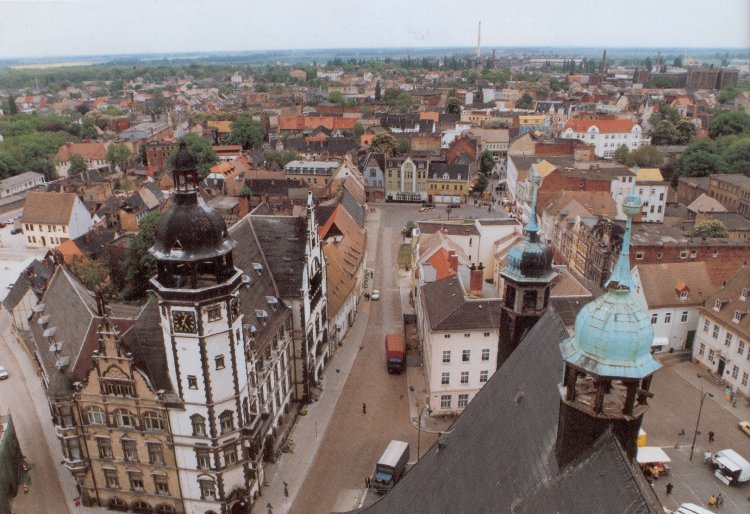 Leopold, Prince of Anhalt-Köthen hired Bach to serve as his Kapellmeister (director of music). Prince Leopold, himself a musician, appreciated Bach's talents, paid him well, and gave him considerable latitude in composing and performing. The prince was Calvinist and did not use elaborate music in his worship; thus, most of Bach's work from this period was secular, including the Orchestral Suites, the Six Suites for Unaccompanied Cello and the Sonatas and partitas for solo violin. The well-known Brandenburg Concertos date from this period. Bach composed secular cantatas for the court such as the Die Zeit, die Tag und Jahre macht, BWV 134a.
On 7 July 1720, while Bach was abroad with Prince Leopold, Bach's wife Maria Barbara, the mother of his first seven children, suddenly died. The following year, the widower met Anna Magdalena Wilcke, a young, highly gifted soprano 17 years his junior, who performed at the court in Köthen; they married on 3 December 1721. Together they had 13 more children, six of whom survived into adulthood: Gottfried Heinrich, Johann Christoph Friedrich and Johann Christian, all of whom became significant musicians; Elisabeth Juliane Friederica (1726–81), who married Bach's pupil Johann Christoph Altnikol; Johanna Carolina (1737–81); and Regina Susanna (1742–1809).
Leipzig (1723–50)

In 1723, Bach was appointed Cantor of the Thomasschule at St. Thomas Church (Thomaskirche) in Leipzig, as well as Director of Music in the principal churches in the town, namely the Nikolaikirche and the Paulinerkirche, the church of the University of Leipzig.[28] This was a prestigious post in the mercantile city in the Electorate of Saxony, which he held for 27 years until his death. It brought him into contact with the political machinations of his employer, the Leipzig Council. The Council comprised two factions: the Absolutists, loyal to the Saxon monarch in Dresden, Augustus the Strong; and the City-Estate faction[clarification needed], representing the interests of the mercantile class, the guilds and minor aristocrats. Bach was the nominee of the monarchists, in particular of the Mayor at the time, Gottlieb Lange, a lawyer who had earlier served in the Dresden court. In return for agreeing to Bach's appointment, the City-Estate faction was granted control of the School, and Bach was required to make a number of compromises with respect to his working conditions. Although it appears that no one on the Council doubted Bach's musical genius, there was continual tension between the Cantor, who regarded himself as the leader of church music in the city, and the City-Estate faction, which saw him as a schoolmaster and wanted to reduce the emphasis on elaborate music in both the School and the Churches. The Council never honoured Lange's promise at interview of a handsome salary of 1,000 Thaler a year, although it did provide Bach and his family with a smaller income and a good apartment at one end of the school building, which was renovated at great expense in 1732.
Bach's post required him to instruct the students of the Thomasschule in singing and to provide church music at the main churches in Leipzig. Bach was required to teach Latin, but he was allowed to employ a deputy to do this instead. A cantata was required for the church service on Sundays and additional church holidays during the liturgical year, he performed mostly his own compositions. The bulk of these cantatas was composed in his first three years in Leipzig, beginning with Die Elenden sollen essen, BWV 75, first performed in the Nikolaikirche on 30 May 1723, the first Sunday after Trinity. He collected them in annual cycles, five are mentioned in obituaries, three are extant. Most of these concerted works expound on the Gospel readings prescribed for every Sunday and feast day in the Lutheran year. Bach started a second annual cycle on the first Sunday after Trinity of 1724, composing only chorale cantatas, each based on a single church hymn, first O Ewigkeit, du Donnerwort, BWV 20, then works such as Wachet auf, ruft uns die Stimme, BWV 140, Nun komm, der Heiden Heiland, BWV 61, and Wie schön leuchtet der Morgenstern, BWV 1. For other than chorale cantatas, a stanza from a chorale typically forms the concluding movement of a work.
To rehearse and perform these works at Thomaskirche, Bach sat at the harpsichord or stood in front of the choir on the lower gallery at the west end, his back to the congregation and the altar at the east end[citation needed]. He would have looked upwards to the organ that rose from a loft about four metres above. To the right of the organ in a side gallery was the winds, brass and timpani; to the left were the strings. The Council provided only about eight permanent instrumentalists, a source of continual friction with the Cantor, who had to recruit the rest of the 20 or so players required for medium-to-large scores from the University, the School and the public. The organ or harpsichord was probably played by the composer (when not standing to conduct), the in-house organist, or one of Bach's elder sons, Wilhelm Friedemann or Carl Philipp Emanuel.
Bach drew the soprano and alto choristers from the School, and the tenors and basses from the School and elsewhere in Leipzig. Performing at weddings and funerals provided extra income for these groups; it was probably for this purpose, and for in-school training, that he wrote at least six motets, mostly for double choir[citation needed]. As part of his regular church work, he performed motets of the Venetian School and Germans such as Heinrich Schütz, which would have served as formal models for his own motets.
Bach wanted to broaden his composing and performing beyond the liturgy. In March 1729, he took over the directorship of the Collegium Musicum, a secular performance ensemble that had been started in 1701 by his old friend, the composer Georg Philipp Telemann. This was one of the dozens of private societies in the major German-speaking cities that had been established by musically active university students; these societies had come to play an increasingly important role in public musical life and were typically led by the most prominent professionals in a city. In the words of Christoph Wolff, assuming the directorship was a shrewd move that 'consolidated Bach's firm grip on Leipzig's principal musical institutions'. During much of the year, Leipzig's Collegium Musicum performed twice weekly for two hours in the Zimmermannsches Caffeehaus, a Coffeehouse on Catherine Street off the main market square. Many of Bach's works during the 1730s and 1740s were written for and performed by the Collegium Musicum; among these were almost certainly parts of the Clavier-Übung (Keyboard Practice) and many of the violin and harpsichord concertos.
In 1733, Bach composed the Kyrie and Gloria of the Mass in B minor. He presented the manuscript to the King of Poland, Grand Duke of Lithuania and Elector of Saxony, August III in an eventually successful bid to persuade the monarch to appoint him as Royal Court Composer[citation needed]. He later extended this work into a full Mass, by adding a Credo, Sanctus and Agnus Dei, the music for which was almost wholly taken from some of the best of his cantata movements. Bach's appointment as court composer appears to have been part of his long-term struggle to achieve greater bargaining power with the Leipzig Council. Although the complete mass was probably never performed during the composer's lifetime, it is considered to be among the greatest choral works of all time. Between 1737 and 1739, Bach's former pupil Carl Gotthelf Gerlach took over the directorship of the Collegium Musicum.
In 1747, Bach visited the court of the King of Prussia in Potsdam. There the king played a theme for Bach and challenged him to improvise a fugue based on his theme. Bach improvised a three-part fugue on Frederick's pianoforte, then a novelty, and later presented the king with a Musical Offering which consists of fugues, canons and a trio based on the "royal theme," nominated by the monarch. Its six-part fugue includes a slightly altered subject more suitable for extensive elaboration.
The Art of Fugue was written shortly before Bach's death and was finished but for the final fugue. It consists of 18 complex fugues and canons based on a simple theme. It was only published posthumously.
The final work Bach completed was a chorale prelude for organ, dictated to his son-in-law, Johann Altnikol, from his deathbed. Entitled Vor deinen Thron tret ich hiermit (Before thy throne I now appear, BWV 668a); when the notes on the three staves of the final cadence are counted and mapped onto the Roman alphabet, the initials "JSB" are found.
Death (1750)

Bach's health declined in 1749; on 2 June, Heinrich von Brühl wrote to one of the Leipzig burgomasters to request that his music director, Gottlob Harrer, fill the post of Thomascantor and Director musices posts "upon the eventual ... decease of Mr. Bach." Bach became increasingly blind, and the British eye surgeon John Taylor operated on Bach while visiting Leipzig in 1750.
On 28 July 1750 Bach died at the age of 65. A contemporary newspaper reported the cause of death as "from the unhappy consequences of the very unsuccessful eye operation". Some modern historians speculate that the cause of death was a stroke complicated by pneumonia. An obituary was written by his son Emanuel and his pupil Johann Friedrich Agricola at the time. Bach's estate was valued at 1159 Thaler and included five Clavecins, two lute-harpsichords, three violins, three violas, two cellos, a viola da gamba, a lute and a spinet, and 52 "sacred books", including books by Martin Luther and Josephus. He was originally buried at Old St. John's Cemetery in Leipzig. His grave went unmarked for nearly 150 years. In 1894 his coffin was finally discovered and reburied in a vault within St. John's Church. This building was destroyed by Allied bombing during World War II, and in 1950 Bach's remains were taken to their present resting place at Leipzig's Church of St. Thomas.
Bach Flute Scores:
- Flute Sonatas, from BWV 1030 to BWV 1035
- BWV 21: Cantata "Ich hatte viel Bekümmernis"
- BWV 209: Cantata "Non sa che sia dolore"
- BWV 212 (oberture): Cantata "Mer hahn en neue Oberkeet"
- BWV 572: Fantasie in Sol
- BWV 867: Prelude in Si bemol menor
- BWV 997: Laud Suite
- BWV 1013: Flute Partita
- BWV 1038: Trio Sonate in Sol Mayor
- BWV 1039: Trio Sonate for two flutes and continuo
- BWV 1050: Brandemburg Concerto N° 5
- BWV 1044: Concerto for flute, violín and harpsichord
- French Suite N° 5
- BWV 1079: Musical Ofering
- Orchestral SUite N° 2
- BWV 140: Coral-Prelude from "Wachet auf, ruft uns die Stimme"
- BWV 21: Cantata "Ich hatte viel Bekümmernis"
- BWV 209: Cantata "Non sa che sia dolore"
- BWV 212 (oberture): Cantata "Mer hahn en neue Oberkeet"
- BWV 572: Fantasie in Sol
- BWV 867: Prelude in Si bemol menor
- BWV 997: Laud Suite
- BWV 1013: Flute Partita
- BWV 1038: Trio Sonate in Sol Mayor
- BWV 1039: Trio Sonate for two flutes and continuo
- BWV 1050: Brandemburg Concerto N° 5
- BWV 1044: Concerto for flute, violín and harpsichord
- French Suite N° 5
- BWV 1079: Musical Ofering
- Orchestral SUite N° 2
- BWV 140: Coral-Prelude from "Wachet auf, ruft uns die Stimme"


